
Choosing Wrought Iron Railings: Design, Fixings and Care
Choosing wrought iron railings involves function, fixings, protective finishes and maintenance access as well as pattern and colour. A balcony edge, staircase and decorative garden boundary do not perform the same task. A design admired in one setting may therefore be unsuitable in another. Start by identifying what the railing must protect and how people will use the area. Then assess its appearance and installation details against that purpose. For a home or business in Denizli, request an assessment of the existing construction and connection conditions rather than asking only for the price of a photograph.
Define the function and the users
A barrier at a balcony edge has a different purpose from a decorative boundary inside a garden. Stair use also involves movement, changes of direction and hand support. Consider the people using the building, nearby furniture and circulation routes. Where protection against falling is involved, dimensions and infill arrangements should not be decided only by appearance. They must be confirmed for the project and the applicable Turkish requirements with an authorised engineer. The owner's role is to explain use and existing conditions, not to infer suitable guarding dimensions or compliance from an attractive reference image.
Relate the pattern to the architecture
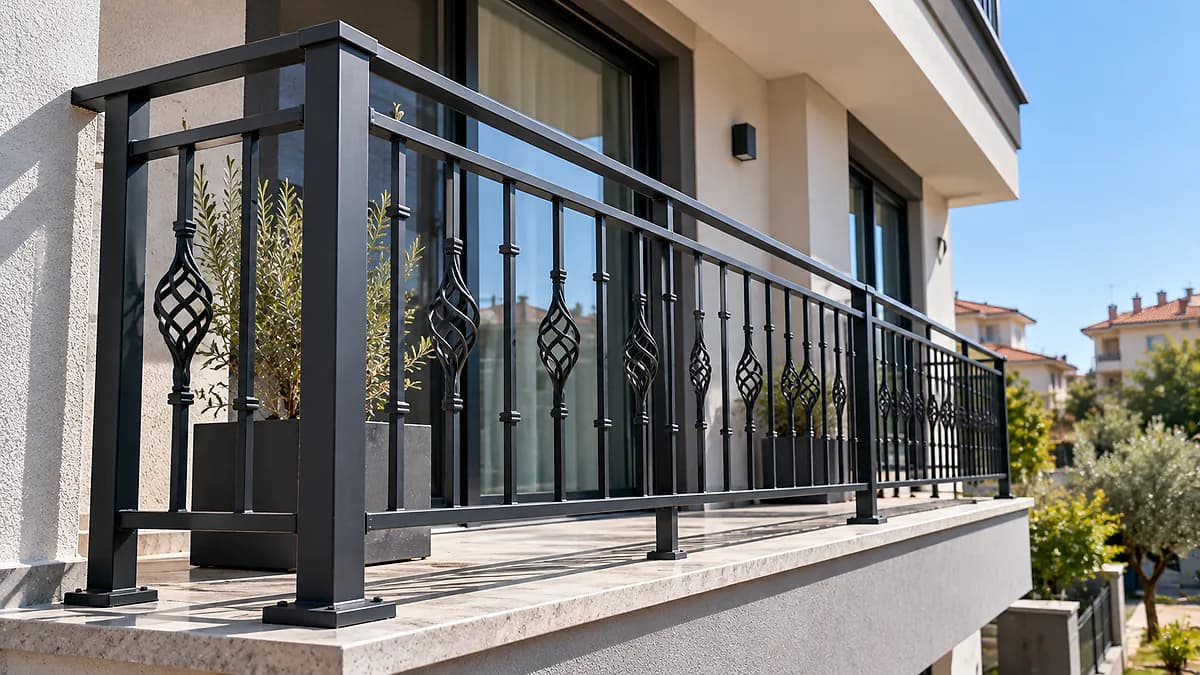
Decorative metalwork may use curved, dense or restrained lines. Consider how the proposal relates to doors, windows, facade proportions and other metal elements. A pattern that works on a small sample can feel different across a long run. A drawing of the complete arrangement helps reveal repetition and corner conditions. Infill density can also affect privacy and cleaning access. Do not choose greater ornament simply because it appears more elaborate. The railing's protective purpose should remain clear, rather than being lost behind decoration or reduced to resemblance to an image supplied at the start of the enquiry.
Request an explicit material description
The term wrought iron is sometimes used broadly for decorative metalwork. Ask for the actual material, member forms and fabrication approach to be described. Appearance alone does not establish that two quotations contain equivalent components. Suitability depends on position and design; this guide does not prescribe section sizes or thicknesses. Discuss how bends, joints and finishing work are included. Associated fixing components should also be identified. This turns the order into a defined installation proposal rather than a model name that different people may interpret differently. It also makes the limits of a visual reference clear before production begins.
Give fixings as much attention as decoration
The receiving construction and its condition need assessment. A new surface finish does not prove that the structure behind it can support the proposed connection. Cracks, loose material and previous holes may affect the decision. Fixing design and load transfer require appropriate professional review. Access to connections concealed by later finishes should also be considered. If installation exposes an uncertainty, agree when it should be referred back to the responsible designer rather than solved informally. An owner's later drilling or attachment can affect the assembly, so alterations should be discussed with appropriate professionals instead of treated as harmless decorative changes.
Consider the whole protective treatment
For external metalwork, surface preparation, the protective system and application quality work together. The final colour does not describe that process. Joints, corners and places where water may collect should be considered during fabrication. Ask how the specified coating relates to preparation and how damage during installation will be handled. A paint or coating name does not establish that maintenance will never be needed. Exposure and use still matter. At handover, obtain care information as well as the colour reference so future cleaning and inspection decisions are based on the product rather than on an arbitrary choice of materials.
Plan observation and maintenance
Follow the finish and product guidance when planning care. Avoid abrasive equipment or aggressive chemicals unless compatibility is established. Owners may notice coating separation, signs of corrosion, impact marks or unexpected movement. Photograph such changes and contact the installer. Where the railing protects against falling, do not try to resolve looseness through an improvised repair. Competent people should assess the condition and appropriate work. Rather than copying a fixed interval from another building, establish a programme around exposure and instructions. Recording interventions helps distinguish an isolated mark from a recurring problem needing further investigation.
A brief model comparison
Restrained lines: Assess architectural fit alongside infill design and cleaning access.
Dense decoration: Review repetition, corners and the number of fabricated junctions.
Coordinated gate and railing: Keep a related appearance while resolving the different functions of moving and fixed components.
Decoration alone does not determine suitability. Use, connections, finishes and project requirements must be considered together. If the same visual language is intended for the entrance, our garden gate selection guide explains why matching appearance does not mean identical working or fixing arrangements.
Clarify quotation and handover scope
Ask whether measuring, fabrication, surface preparation, finishing, transport and installation are included. Clarify removal of existing railings and any repairs to the receiving surfaces. Drawings can identify which features of the reference design will be retained. At handover, review the agreed arrangement, fixing condition and finish with the competent installer. Record care instructions and any outstanding work. When discussing our decorative railing service, compare the scope of the completed work rather than the design price alone. That makes differences between proposals more visible and gives the owner a clearer record of what has been supplied.
Frequently asked questions
Can any decorative design guard a balcony?
No. Protection against falling, infill, dimensions and fixings require assessment for the location. The appearance of a model is not a substitute for professional review of its suitability and the project's requirements.
Does colour show the protection level?
Colour alone does not identify preparation or establish the suitability of a protective system. Product, application and exposure all matter. The quotation should describe the finishing process, not simply name a shade.
Can an old railing be repaired?
Damage, connections and the existing components need inspection. An apparently superficial issue may require a wider assessment. Whether repair is sufficient or replacement is appropriate should be decided after the condition has been evaluated.
Share photographs and your requirements through the quote request form. Hünerli Metal can use them to discuss the design, installation and maintenance scope together.