

Garden Gate Options for Homes and Business Entrances
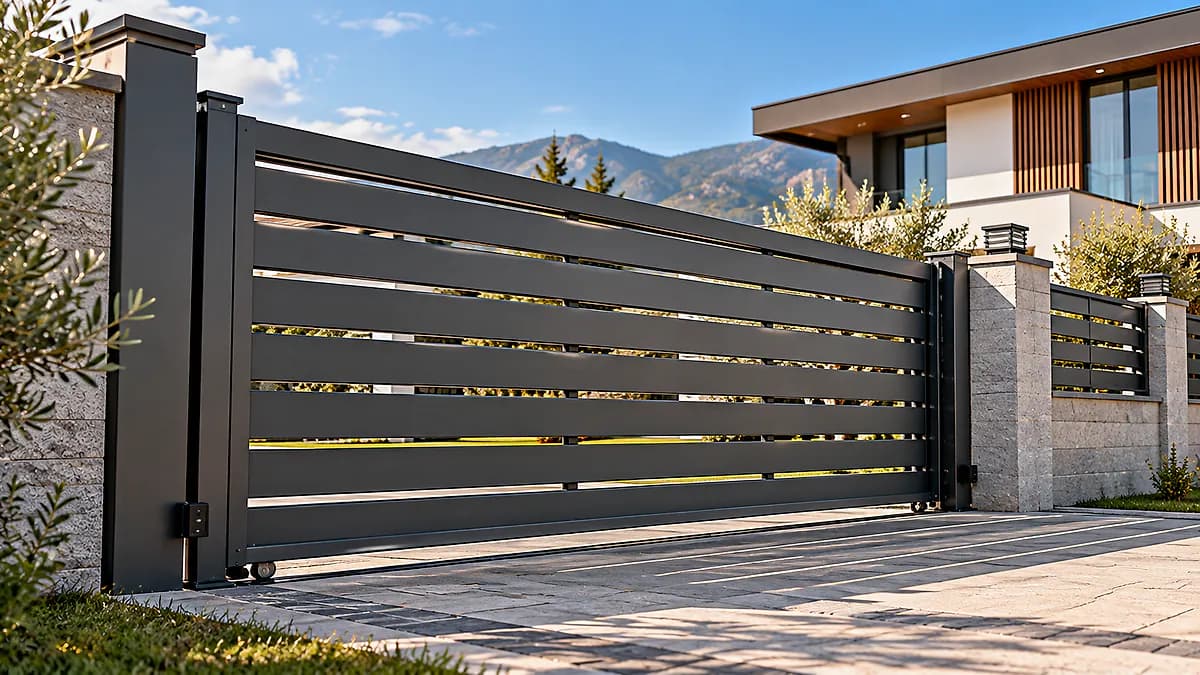
Garden gate options should first be compared against the available space and the way the entrance is used. Choosing swing or sliding movement involves more than appearance: ground, opening space, pedestrian access, privacy and maintenance all matter. A home entrance and a business yard may present quite different traffic patterns. If powered operation is proposed, safety requires its own assessment. For a gate project in Denizli, start by recording where and how the gate must work rather than selecting a model photograph. This guide explains the questions that help turn that preference into a defined entrance proposal.
Think of the entrance as a movement area
A gate is not only the surface visible when it is closed. It is a moving assembly that occupies space while opening and closing. Consider vehicle approach, turning, parking and the circulation outside the boundary. A vehicle fitting through the clear opening does not prove that the whole entrance is convenient to use. Approach angle and the gate's movement also matter. Photograph existing walls, posts and planting, and identify slopes or places where water collects. These observations inform the survey. Measuring only the distance between two walls does not describe the full operating area or establish a suitable system.
Assess the space needed by a swing gate
A swing gate needs a clear arc for its leaves. Leaf arrangement and opening direction should be reviewed with the existing entrance. Parked cars, sloping ground and objects in the movement area can affect operation. Infill also needs consideration alongside wind effects and the supporting connections. Hinge and fixing design cannot be established from a photograph of the model. Think about how other users share the opening area. At a communal entrance, considering pedestrians and vehicles on the same layout can expose conflicts that are easy to miss when the discussion focuses only on the closed gate's appearance.
Check the side space for a sliding gate
A sliding gate moves sideways, so assess the space beside the opening. Track-based and other support arrangements involve different details depending on the design and site. Ground condition, drainage, debris and maintenance access should be discussed. An apparently clear strip beside the entrance is not sufficient evidence of suitability; obstacles and connections must be considered throughout the movement. At a business premises, loading or temporary storage may block that area. The operating space needs to remain available during normal use. Select the technical arrangement with competent installers and appropriate design professionals rather than treating lateral movement as an automatic solution.
Balance privacy with visibility
Dense infill, open bars and decorative patterns create different appearances and operating conditions. A homeowner seeking privacy should also consider the driver's view when leaving the plot. At a commercial entrance, access control and traffic arrangements may add other priorities. Do not treat infill as purely aesthetic: wind effects and supporting design need attention too. Explain which feature of a reference image you prefer. A gate shown on another site may not operate in the same way on a different slope or approach. The model should be reassessed against the actual use, rather than accepted as a ready-made installation design.
Plan pedestrian use separately
Using the vehicle opening for every pedestrian is not necessarily a suitable arrangement. Assess whether a separate pedestrian gate or another access approach is needed. Discuss children, visitors, deliveries and people with different mobility needs. Clarify how access works with locks, communication equipment and the building's day-to-day operation. Record lighting and visibility limitations early. A single general dimension cannot resolve these questions for every entrance. The aim is to treat the gate as part of an entrance serving different users, not only as a barrier that allows vehicles to pass when the opening is clear.
Powered operation needs a safety assessment
Adding a motor should not be treated only as remote-control convenience. Competent people need to assess moving components, trapping points, users and foreseeable faults. Protective measures, controls and maintenance requirements depend on the complete application. One sensor does not demonstrate that all risks are resolved. Users should not disable safety equipment or normalise repeated faults through temporary adjustments. Identify motor, electrical and safety responsibilities explicitly in the quotation. Discuss which work Hünerli Metal will undertake and which items need other specialists; this article does not promise that every automation service is part of the metal fabrication scope.
A short comparison framework
Swing: Check the opening arc, ground and interaction with other activities.
Sliding: Review side movement space, support arrangements and maintenance access.
Powered: Add a competent risk assessment and safety checks to mechanical suitability.
Pedestrian access: Plan how people enter alongside vehicle operation.
This is not a ranking of price or safety. Site conditions determine which options deserve evaluation. If fixed metalwork is being coordinated with the entrance, our railing selection guide explains how a related visual design can still involve different functions and connections.
Clarify care and handover information
Finishes, hinges, moving components and any automation may need distinct care information. Handover should explain the relevant instructions, how problems are reported and which specialists to contact. Methods depend on the product and system. New noise, rubbing or irregular movement should be assessed by competent people rather than addressed through improvised adjustment of a heavy leaf. When discussing our garden gate fabrication service, clarify removal, new fixings, surface repairs, transport and installation. This identifies the work needed for the complete entrance, rather than reducing the proposal to the visible model and its supply price.
Frequently asked questions
Is sliding always best for a confined entrance?
No. Side space, support, ground and operation require assessment. Limited space in front does not establish that lateral movement is suitable. Feasibility must be considered for the actual entrance.
Can an existing gate be powered later?
The mechanical condition and safety of the complete moving system need competent review. Motor capacity alone is insufficient. Risks, users and protective arrangements must be assessed together before a conversion is agreed.
Which photographs help with an enquiry?
Show the entrance from both sides, adjacent movement space and ground. Add approximate dimensions, vehicle types and expected use. These details support the first discussion but do not replace a site survey.
Send entrance information and your priorities through the quote request form. Hünerli Metal can then discuss appearance, operation and installation scope as parts of the same project.